Lessons from the Amador Water Agency Disinfection Byproduct Management Study
How do you keep drinking water safe from pathogens without creating a different problem in the process? And how does a utility catch that problem before it becomes a violation?
Those are the kinds of questions that bring operators, engineers, and utility staff together at the 2026 Intermountain Section of the American Water Works Association. This year, Keller contributed to the conversation through a presentation on the Amador Water Agency Disinfection Byproduct (DBP) Study.
What We Shared: Key Takeaways from the Amador DBP Study
Bryan Phinney, PE, D.WRE and Michael Clark, PE, CFM, presented Amador Water Agency Disinfection Byproduct Study, a project examining DBP risk across the agency’s treatment and distribution systems.
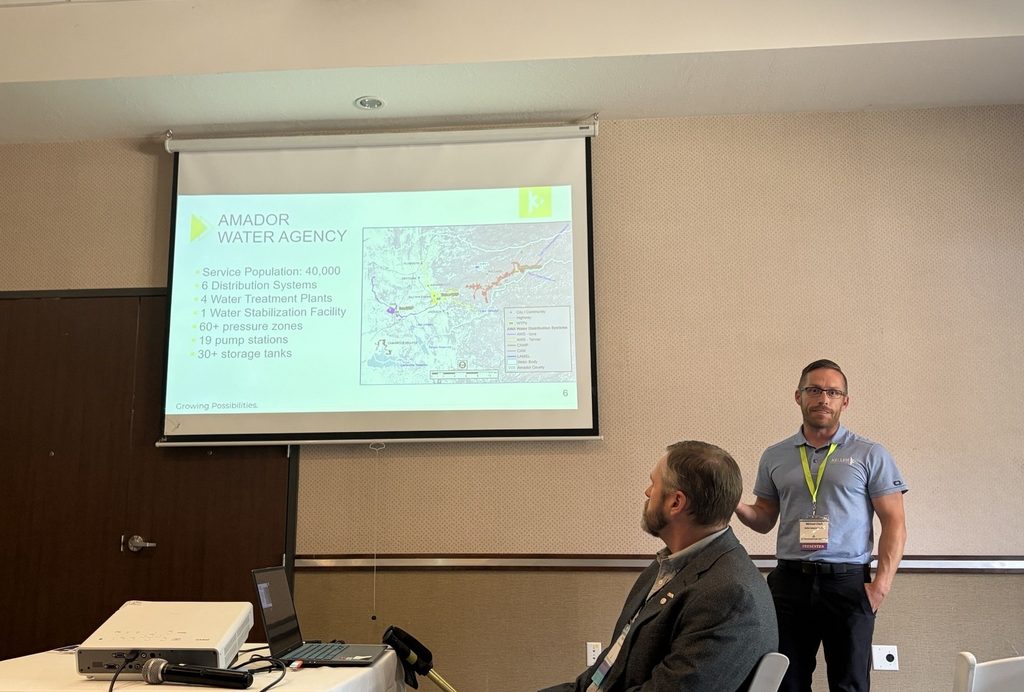
Amador Water Agency operates five treatment plants totaling 10.6 million gallons per day and six distribution systems serving approximately 40,000 people. Four of those systems were experiencing elevated DBP levels and facing a growing risk of violations.
DBPs form when chlorine reacts with naturally occurring organic matter in source water. While the chemistry is straightforward, the challenge is not. Every system behaves differently based on source water quality, treatment processes, chlorine dose, contact time, temperature, and pH.
“Water authorities may need to look beyond single-point chlorination.”
– Amador Water Agency Disinfection Byproduct Study
To better understand the issue, the team looked across the agency’s systems, reviewed treatment alternatives, and developed recommendations tailored to Amador’s facilities and water sources.
The team found that reducing organic material to the desired level would require coagulant doses two to four times higher than those used for conventional turbidity removal, exceeding the capacity of existing solids-handling facilities.
The study reinforced a simple but important lesson: the fix has to fit the system. Successful DBP management requires solutions tailored to each system’s unique conditions.
That insight ultimately informed four capital improvement projects at the Tanner and Ione water treatment plants. It also guided operational improvements and a long-term monitoring strategy to reduce DBP risk and support future compliance.
Discussion continued after the presentation, with engineers and operators from some of the region’s largest water systems asking great questions about testing techniques and treatment alternatives while sharing lessons from their own systems.
Applying the Lessons
The list of regulated disinfection byproducts is likely to grow, making routine monitoring an important tool for utilities looking to stay ahead of future requirements.
Sharing lessons from studies like this helps other utilities think through similar challenges in their own systems.
As the Tanner and Ione improvements move forward, Amador’s experience offers a useful reminder for other utilities facing similar water quality challenges. Because the right solution starts with understanding the system.
Need support with water quality, treatment, or compliance? Explore Keller’s water expertise >>